Sunday, August 4, 2013

Word Study Flashcards To Improve Spelling

For over a year now, I've been selling Word Sorts, or Word Study Flashcards through my Teachers Pay Teachers store. 
I have all the different Spelling Stages available there:
  • Letter Name Alphabetic Stage -  includes short vowels and mostly three letter words like "cat"
  • Within Word Pattern Stage - includes long vowel patterns and r-influenced vowels
  • Syllables and Affixes Stage - includes prefixes and endings as well as multi-syllabic words
  • Derivational Relations Stage - include Greek and Latin Roots
I created these sorts when I was doing my student teaching. I printed and laminated a set for my host teacher and a set for myself, at least for the sorts I taught that year. I copied each set on different colors, so that if the students were working together, they could make sure the same color got back in the correct set at the end.

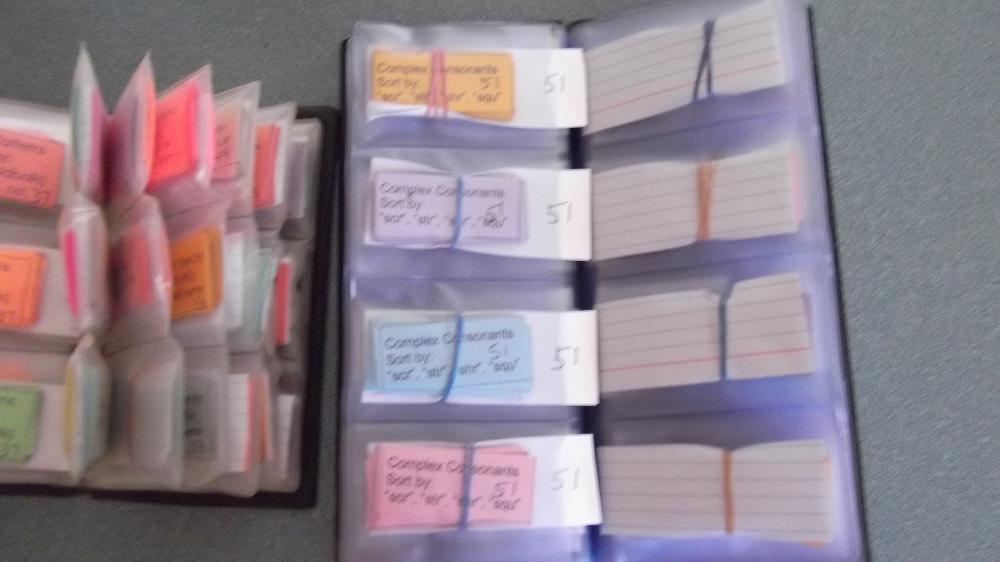
This summer, my mom helped me cut out my set and organize them. She added the number for the sort on the back of each card, cut them apart and secured them with a rubber-band.

My dad had a business card holder that he was no longer using, which I put the cards in. To make it easier to take the cards in and out of this, I added an index card, which I cut down to size. I made sure it stuck out of the plastic, as a tag students can grab.

In the future, I may only make 3 of these copies for each sort. I would have the students work in pairs at a word study station with 2 of the copies. I plan to add magnetic tape to one set of cards for each sort, so students can sort on the side of a heater or file cabinet. I would have copies on plain paper that students can take home for further practice.


Monday, May 27, 2013

Brine Shrimp Hatching Lesson


Lesson: Brine Shrimp Hatching - Taught February 19, 2013

Objective:
Work collaboratively with other students to set up a controlled experiment to answer the question:
What is the optimum salinity (salt level in water) for brine shrimp eggs to hatch?

EALRs:
4-5 INQB Investigate (Inquiry) Scientists plan and conduct different kinds of investigations, depending on the questions they are trying to answer.
4-5 LS1C (Life Science) Certain structures and behaviors enable animals to respond to changes in their environment.

Anticipatory Set: Looking at Brine Shrimp Eggs in their dormant stage using a magnifying glass.
-Prepared in advance 28 cups and lids w/ 1 mini-spoon of brine shrimp eggs and a magnifying glass.
“What do these brine shrimp eggs need to hatch?”

Activities:
In Science Journals:
1. Discuss the Question, Background Research, and Hypothesis students started last week.
2. Distribute copies of Materials List and Procedure for the Investigation (see attached).
3. Students identify controlled variable, manipulated variable and responding variable.
4. Preview the list of procedures/ directions.

Label cups (Pre-prepared labels)

Distribute salt (Pre-prepared: cups of salt w/ 5ml spoons)
Students put in the correct amount of salt in each cup
Line the cups up in order and take a picture with iPod
iPods go in “Time out tubs” and put to the side for next step

Restate: “What type of variable is the water?” (controlled)
“IMPORTANT: only 150 ml of water in each cup. How much?”
Distribute water
(Pre-pared: cups of water, 150 ml measuring cups, stirring rods)
Students pour in 150 ml of water in each cup and stir
Line the cups up in order and take a picture with iPod
iPods in “Time out tubs” and put to the side for next step

Store cups on trays in the window for follow up next few days.

Conclusion:
“What type of experiment are we conducting?”
“What question are we trying to answer?”

If time: Set up Science Journals to Record Data for the next 2 days.

-HANDOUT-
Materials:

Brine Shrimp Eggs (______________________   variable)

Salt                          (______________________   variable)

Water                       (______________________   variable)
4 congruent cups with lids
Labels
Magnifying glass
5ml spoon to measure salt
100 ml measuring cup to measure water
Camera (optional)

Procedure:

Getter # 1 – Get Tray
1.     Tape brine shrimp eggs sample in Science Journals.
      Put 1 mini-spoon of brine shrimp eggs in each cup (already done).

Getter #2 – Get Salt with 5 ml spoon
2.     Label the cups and ADD SALT in varying staged amounts:
Cup 1: 0 spoonfuls of salt (0 ml)
Cup 2: 2 spoonfuls of salt (10 ml)
Cup 3: 4 spoonfuls of salt (20 ml)
Cup 4: 6 spoonfuls of salt (30 ml)
      LINE CUPS UP AND TAKE A PICTURE
      PUT iPods in TIME OUT TUBS AND PUT OFF TO THE SIDE

Getter #3 – Get Water and Measuring Cup
3.     Add 150 ml of water to EACH cup
     Gently swirl to dissolve the salt.
LINE CUPS UP AND TAKE A PICTURE

Returner –
4.     Put Lids on and store the cups in a safe place.
Clean up other materials

5.     Record results on Day 2 and Day 3


POST LESSON REFLECTION:
This was a very successful lesson. The students were engaged throughout the lesson. The time and forethought I put into prepping the lesson paid off! If I were to teach this lesson again, I would definitely prep the materials in advance, as I did this time. It saves so much time in the distribution process. I would also use the same handout as it laid out clear and specific tasks for the students.

Looking back, it probably would have been better to use the doc cam to show students how to measure the salt, especially the process of starting on the flat edge to scrape of the excess salt. I wasn't sure students would see the flat/ levelness of the spoon under the doc cam. If I were to teach this lesson again I would use the doc cam to show the process, and then walk the spoon around to show the flat level.

Here is the evidence I observed that I met my objective: When it was the students turn to work, I observed the majority of student taking turns (working collaboratively) to measure the salt and the water. Sometimes, a few students wanted to do most of the work and needed some gentle reminders to share responsibility. For instance, one student was trying to measure water for a second cup, although he had already measured water and the other students were asking for the opportunity to measure. Another student wanted to measure all the salt in the cup that required the most salt. They responded well to gentle reminders to work together.

For the controlled experiment portion I noticed the varying amounts of salt (manipulated variable)  in all the cups before the students took their first picture, and that all the cups had same amount of water (controlled variable) after they took their last picture. I can use their iPods as an assessment tool; to make sure they took the pictures, and that the measurements were correct. I may not have iPods in a future classroom, so I would have to take that into consideration if teaching this lesson in the future.

I decided to say "stop, freeze, look at me" just as they were beginning to measure the water rather than use the "scientists" signal, because most students were working well and I wanted to share a quick piece of information without disrupting their work too much ("DO put water in the cup labeled 0ml"). In other words, I did not want them to have to completely empty their hands to hear that tidbit of information. 

When I am not teaching science, I often use two signals to get students attention. Usually, I say"1, 2, 3 Eyes on me" Students say, "1,2 eyes on you, hands folded too." This is similar to the "Scientists?" cue as I can quickly scan the classroom and see who has their hands folded, which prevents students from playing with papers, etc. when I am giving instruction. Sometimes I say, "Stop, freeze, look at me" and I scan the room for eyes and no movement. I find that useful for giving quick information I may have forgotten to mention, or when I realize something should be clarified. I do need to work on making sure I have 100% of students' attention 100% of the time I ask for it, and I need to follow up with restating expectations when necessary. 

Another practice I have been implementing into my teaching purposely includes wait-time and choral responses. I will thrice ask a question that requires a one or two-word response. I tell students "Raise your hand if you know it. Don't blurt it out" between each time I ask the question, and I will raise my hand at this point. Then, I will say, "When I drop my hand, whisper it if you know it." This encourages all to participate, without being disruptive. 

During the lesson, I realized the salt was not going to dissolve with simple swirling. So, I would definitely plan to distribute Popsicle sticks as part of the lesson next time. 

After the lesson, I was able to repeat the procedure with a couple of students who had been pulled out. As a full time teacher, I would offer the opportunity to students who may have missed a lesson to repeat it during lunch recess, or before or after school. 

The students looked for the brine shrimp eggs to hatch over the following days. They did not notice anything until Friday. They were so small; the size of a comma. I had a hard time noticing them. If I were to teach this lesson in the future, I would actually teach it on a Friday, rather than a Tuesday to allow the brine shrimp time to hatch over the weekend. 

As a full time teacher, I plan to teach Science on Fridays. Students will think it is "Fun Friday" because science is so engaging. They might not realize how much they are actually learning!
Project Based Learning (Tier 2) Reflection

This year, I took "Tier 2" Technology Training through my school district. Below is the final reflection I submitted for the program:

Teachers Teaching With Technology
Project Based Learning
Final Presentation Reflection
Teacher: Sarah Hart (Substitute)
Project Theme/ Topic: Science - Environments

General overview/ description of the project: I taught the FOSS Environments Module to a fifth grade class to prepare them to create their own Science Fair experiment. The students used iPods to take pictures and video of Science Investigations in progress and to listen to audiobooks of the Science stories that accompanied the Investigations. I also introduced "models" and "landforms" to the students using technology -specifically, www.sketchup.com, 3D photography and Google Earth.

1. The key skills my students learned during this project include: the steps of the Scientific Method, and how to create a science fair project.

2. The way I assessed these skills: Formative Assessments included a Science Journal and quizzes. The Summative Assessment was a Science Fair Experiment, assessed by high school AP Science students, using a checklist.

3. The example of student work that I want to share with my colleagues will be: Pictures and video of student work.

Reflection:
1. The most important thing I learned about Project Based Learning and my teaching is that pre-teaching lessons helps lead to a successful result in completing investigations. In some ways, I think this is in-between traditional teaching and true project-based learning. However, I do feel this is necessary to model proper behavior in order to still maintain a degree of classroom management. With specific directions and modeling, the students know what they need to do when working on their own.

2. The most important thing I learned about
Project Based Learning and student learning is that students work well independently when given clear expectations for their roles and final projects. The students Science Fair Experiments turned out excellent. Also, they worked well in a "Jigsaw" project to learn about systems. They were engaged throughout the lessons.

3. What I learned about planning and implementing Project Based Learning is to "begin with the end in mind." In other words, lay out exactly what you expect to be in the final project. Tell the students these expectations. I also found that setting clear roles for students helped the investigations run smoothly. The time spent in planning is well worth the investment. The science investigations required quite a bit of preparation. I set up stations for them to get the required materials, and for a couple Investigations, I did a bit more prep work. For example, I added brine shrimp eggs to 28 cups in advance of one investigation, since there was one small glass bottle, and it would've taken more time for the students to do that step.

4. Perhaps in the future, I'd like to do a little less prep and see if the students can take responsibility for setting up the investigations more themselves.

5. The biggest struggle with this project was a few students who posed behavior problems.

6. To overcome the challenge posed by these students, I frequently checked with them during investigations. For one lesson, a couple students sat out and then I worked with them later to perform the investigation. Fortunately, I had the support of a full-time teacher to do this. If I were a full-time teacher, I would set aside time before or after school, or lunch to work with students if necessary.

7. I am really proud that I had the principal observe me for one of the investigations, and it went really well. I am also very proud of the students' final Science Fair projects. They all put a lot of work into these projects.

8. I was really supported by Brandy Ross, who allowed me to adopt her classroom. She was a great mentor. One thing I learned from her is "don't talkover students." This is great as a classroom management strategy. The way I remind myself to follow through with this is to tell myself: "what students have to say is important; allow them to finish." The high school science teacher brought her AP students to judge the elementary school students projects, which I think is a great Community of Practice support.

9. Next year, if I get hired in the librarian position, I will apply for Tier 3 in order to get iPods in the hands of as many students as possible. Otherwise, I may apply to Tier 2, Take 2.
I have recently started a blog: http://hartoflearning.blogspot.com and a Youtube channel: http://youtube.com/hartoflearning - I have already posted the lesson I did on Google Sketchup. I may do some more video lessons to help "flip the classroom," and teach students in general.

Sunday, May 26, 2013

First Grade

A total transformation happens between the beginning and end of first grade. At the beginning of the year, most students can't read. Their writing consists of simple sentences and copying teachers' writing. By the end of the year, most students can read independently. They can also write short paragraphs about a subject, using "inventive" spelling for words they don't know.

I believe this is a key time in education, which sets the patterns in place that a student lives by for the remainder of their lives. That is why it is important to have clear, specific expectations for students in first grade, starting with letter formation. Make students erase letters that are not neat and rewrite them. This tells students there is a correct way to write the letters. I have excellent handwriting myself, and I believe it is because my first grade teacher demanded I write my letters neatly. My mother told me she found a paper with tears on it from my handwriting practice during my formative years.

This reminds me of the interesting ways students sometimes try to avoid doing work. Some students will cry, others will throw a fit, and some will act like a clown. As a teacher, I must look beyond all of this and push students to reach their potential - telling students, "You can do this. I believe in you." When they correct their mistakes, I say, "Great job!" as they beam with pride.

Here are some ideas I like from first grade classes I've worked in:

As students enter the classroom, have a chart with  pictures of the "Enter Routine"
1. Turn in folder
2. Hang up jacket and backpack
3. Choose your lunch
4. Start morning work.

Students have a specific way to choose their lunches:
Some classes use clips on a cardboard chart.
One teacher has kids put cards with their lunch number in a baggie that is hanging by a magnet on her file cabinet. Then, she hands these cards to students when they go to lunch.

For discipline, students start out with their clip on green- "Good Day"
For bad behavior, they move down to "Slow Down" -yellow 
Then down to "Time Out" -red
For good behavior, they can move up to "Excellent" and then "Outstanding"

Some teachers I know have excellent routines for calendar, reading and math. At the beginning of the year, the teachers run through the routines, and slowly incorporate student jobs and hand over reesponsibility. One teacher has students read through all the sound spelling cards they have learned so far- saying the picture, the sound, and repeating the sound and spelling each pattern. The Math Expressions curriculum lays out a great plan for incorporating student leaders as well.

Just remember, as teachers, we are laying the foundation for tomorrow.

Saturday, May 11, 2013

Safari Montage

This week, I went to a training for using Safari Montage. Our district pays for this software, which has educational videos we can use. You can search by subject or keyword. Each video or resource lists whether it has closed captioning and even links to the Washington State standards that apply. What is really cool is that you can take smaller snippets of the video, by customizing the start and end times and adding it to a custom built playlist. There are also other resources you can use, like quizzes and interactive sheets. You can even add Smart Board lessons, or notebook files, into your custom playlist.

There are a lot of potential applications for using Safari Montage. For instance, videos that have closed captioning will increase students' literacy (even more so if you turn down the audio and ask students to read the screen). Another cool feature is that you can set itt to move automatically into the next event in the playlist, unless you add an interactive aspect. This helps with time management when you know you only have a certain amount of time to cover material, especially when teaching in the library or middle and high school levels.I am looking forward to creating playlists I can use for various grade levels.

Monday, May 6, 2013

Librarian

This week, I subbed for a librarian who is retiring. I also applied for her job, and I have her and another school librarian I respect as references. Even if I don't get the job, I may look into getting a "Learning Resources" endorsement. I'll contact Western Governor's University next week to see if they offer a program, since I'm already accepted there.

Some of the things I learned this week are little things to make the library run smoothly, like teaching kids to line the books up so I can scan them quickly. I like the forms one of the schools use to have students request books. I may alter that form, so the same slips can be put in the books when they come in, by putting the teacher's name on top. That way I can grab the books on hold when a particular class comes into the library.

As each class came in, I introduced myself and told them that a signal I use is "One two three, eyes on me" to which they should respond, "One, two, eyes on you, hands folded too." We practiced the signal, then I taught a small lesson before giving them time to check out.
I read a cool book to the Kindergarteners and first graders called "Mousetronaut" by Astronaut Mark Kelly, who is Gabrielle Gifford's husband. Then, I gave the kids who could not check out a coloring sheet. I gave the students who could check out, their cards with their patron number on it, and a shelf marker. For some of the Kindergarten classes, I reminded them how to use shelf markers, with explicit instructions.

For the second grade classes, I taught them how to shelve Fiction Books using a lesson on the Smart Board. Since only one person can touch the smart board at a time, I made little cards for the students to sort at tables while other students were at the smart board. This increased the student engagement in the lesson.

For the third and fourth grade classes, I taught about the Dewey Decimal classification system for Nonfiction books. This was a good refresher for me. I like to think of the 10 sections as a progression:
000s are General Information -where we put things that don't belong in any other category
100s are Philosophy and Psychology - How people think and how people feel; I think of this likse journaling
200s are Religion and Mythology - how people think about where we come from
300s are Folklore and Social Science - stories from past generations, from around the world and about the world
400s are Language - to help you communicate with people around the world after you learn about them
500s are Math and Science - the universal languages
600s are Technology - things you produce with math and science
700s are Arts and Recreation - everything else you can produce
800s are Literature - plays, poems, and collections of children's books
900s are History - when and where things happen

I introduced a cool internet resource, www.proquestk12.com, to some of the fifth grade classes. This is a great resource for doing research, which they can use in the middle school next year too.

As I am thinking about the possibility of actually becoming a full-time librarian next year, I have some interesting ideas I would consider implementing. One idea is to create a club of "shelf elves," consisting of 4th and 5th graders who would like to shelve books during their lunch recess time. They would have to pass a test to be included in the club, but they could get a perk like a free book from the book fair. Another idea is to use some of the library time for "Reading Buddies." For instance, if I scheduled an upper grade back-to-back with a primary grade, the upper grade students may be able to stay an extra 10 minutes and read to the younger students. I think this will help build the school community.

Finally, I would apply for the Tier 3 training and try to get a class set of iPod touches. It would be great to use these with as many classes as possible, in order to get the technology into more hands. I would assign numbers to students in every class, and check that all are put back before each class leaves the library. Now, I will have to wait and see if I get the opportunity to interview for the position.

Monday, April 29, 2013

Middle School Matters

This week, I taught the entire week, including two days at the middle school: 6th and 8th grade Health. In 6th gradeon the first day, Citizens Against Domestic Abuse (CADA) volunteers came and gave a presentation about healthy relationships. They played a really cool youtube video called "Perspectacles." The entire message is that you can't always judge someone on outward appearances, ans small kind messages can change someone's attitude.

The next day, I did a follow up with this. I had the students write positive messages on stars and hearts that I die-cut before school. Then, I had them post these in the hallway towards the end of the period. It was interesting to see the ripples that happened from this action. My 8th grade students came in with these messages taped to themselves. I talked to them about believing these words, and reposting them in the school. "You're beautiful. You're smart. You can do it."

The 8th graders were quite a bit more unruly than the 6th graders. I thought they would be able to work independently on their assignments: to answer some questions in a book and to work on a poster about different systems of the body. I ended up calling on students to read the questions and parts of the text aloud. One student I called on said he didn't know how to read. So, I had him echo me. I read the sentence, then he read it. Later, I allowed them some time to work independently. I made sure to check in on the student who said he couldn't read. I sat by him, and had another student sit by me who seemed to be struggling with the assignment. They were able to work well when I gave them specific guidelines. Another 8th grader seemed like he was being disruptive, but he ended up being one of the earliest finishers, although his work was pretty sloppy.

In the final class of the day, one of the students came in late. When I gave him clear specific directions, he tried to walk away. I followed him, told him to sit down, open his book to a specific page number. He sat, but he said he wanted me to leave him alone. I said, "I will not leave you alone until I see you doing your work." He asked if he could do his work somewhere else, and I sent him to the office with his assignment. I called to let them know he was on his way with work to do. I want my students to know I care about them and their education. I have high expectations for them because I know they are capable. I want them to know they can't hide from me. I see them and I believe in them.


In one of the 8th grade classes, a parent was escorting her child to class and sitting in the back of the room while her child studied. I commended her for caring about her child. If I were to teach middle school full-time, I realize there would be a lot of phone calls home, to establish rapport with the families. I would encourage other parents to escort their child if it will help them.


Another thing I would do as a full-time middle school teacher is "flip the classroom" by recording my lessons on video. Homework would be for the students to watch these videos. Then, they could do the practice work in class, with me there to mentor them. This would require some advanced preparation on my part, but it would be well worth it. This may free up enough class time for students to do more self-guided projects, like writing grants and stories in Language Arts, or students could design their own experiments in Science.


Some full-time positions have finally been posted for my district. I'll be applying to most of them. I have a good feeling that I may get hired full-time for next year. I may take the tests to get highly qualified in Middle School Math and Science.